
Dedicated Client Vaults Are Ready for Allocators
Self-serve onboarding is live for Dedicated Client Vaults: allocators can now set up and fund an individually segregated, on-chain discretionary mandate directly. Connect your wallet, complete onboarding, and deploy on your own terms.

In April 2026, at Vault Summit Cannes, we introduced Dedicated Client Vaults: individually segregated, on-chain portfolio management for institutional capital, operated under Tesseract Investment Oy's MiCA authorization. In the months since, we have run a pilot with a select group of participants, including 21Shares and BitGo, testing the product against real institutional requirements. Today we are opening that access up. Self-serve onboarding is ready for allocators: you can now set up and fund a Dedicated Client Vault directly, on your own terms.
For a treasury, a corporate, a family office or a sophisticated investor weighing how to put digital assets to work on-chain, the first questions are rarely about the headline rate. They are structural. Am I pooled with other clients, or am I alone in this structure? Do I keep ownership of my assets? Who is accountable for managing them, and under what regulatory regime? If something goes wrong in an underlying protocol, how is my claim tracked, and can I reach it directly? If a product cannot answer them cleanly, the rate is beside the point. It should not get past the due diligence process.
Dedicated Client Vaults were built to answer such questions by design, and now you can set one up yourself.
Single-client by design
A Dedicated Client Vault is functionally equivalent to a Separately Managed Account in traditional asset management, rebuilt on-chain. When you create one, it holds only your assets, in a dedicated smart contract assigned to you alone. There is no shared pool, and segregation is enforced at the contract level. Your assets, your returns and your risk exposure are attributable solely to your vault.
The vault is managed by Tesseract Investment Oy, which is authorized under MiCA to provide custody and administration, portfolio management, and transfer services for crypto-assets. Each vault is run as a discretionary portfolio management mandate within the scope of that authorization. The token your vault issues represents a balance in your vault, not a fund unit and not a tradable share. It is non-transferable, with no secondary market and no fungible shares, so the securities-classification question that complicates pooled vaults does not arise.
Connect, onboard, deploy
The path from interest to a funded vault is three steps, and you control each of them.
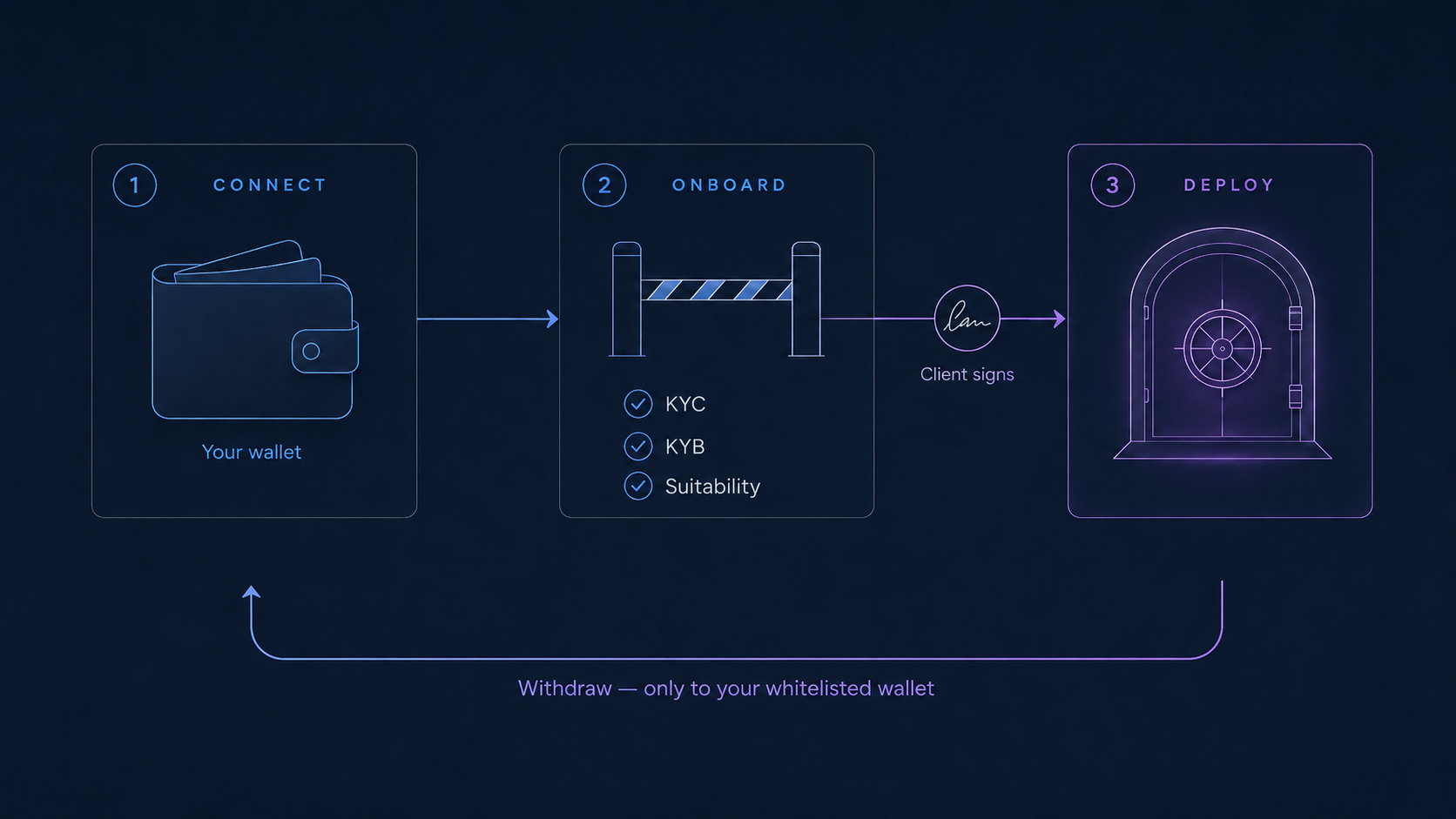
First, you connect your own wallet. Nothing moves, and Tesseract never takes custody of your keys or signs on your behalf. You are simply establishing the wallet that will own your vault.
Second, you complete onboarding: KYC and KYB checks and a suitability assessment. This is the standard of diligence a regulated counterparty is expected to apply, and it is the line between a regulated service and a vault that anyone can deposit into.
Third, once approved you can deploy. You select your strategy, create your vault, allocate capital to it, and sign the transaction yourself. From there, Tesseract manages the strategy within the vault, and you can withdraw back to your own wallet. Withdrawals can only ever be made to a wallet address you have whitelisted as your own.
An extension of your custodial perimeter
For institutions, putting digital assets to work on-chain has usually meant a trade-off: the protections of qualified custody on one side, the opportunities of on-chain finance on the other. Reaching a Dedicated Client Vault through your own custody removes that choice.
Eligible clients of BitGo can now reach their vault directly from BitGo qualified custody, through Narval's institutional gateway. There is no new wallet to create and nothing to migrate; you connect the custody wallets you already use. Assets stay inside the custodial perimeter throughout, and every transaction is decoded into plain terms and checked against the vault's approved venues before it is signed. Your existing governance stays in force, too. Because the vault is reached through your BitGo custody, moving capital into or out of it runs through your own approval workflow, and a transaction can require your designated approvers, on your terms, before it executes. Tesseract manages the strategy within the vault; you keep the controls around it. If you have spent time getting your custody right, the appeal is simple: you put capital to work on-chain from your custody, without stepping outside the controls your team already runs.
Governance and oversight
A Dedicated Client Vault operates inside a defined mandate, and capital is only ever deployed to a curated set of venues that our risk team has assessed and approved, and the vault cannot act outside that set. Approving a venue is a controlled process, and operational responsibilities are separated, so no single person holds end-to-end control of a vault.
Our risk team selects and monitors those venues for security and liquidity, with alerts raised when conditions move outside set parameters. The counterparties and wallets a vault interacts with are screened before they are admitted, and the smart contracts that hold and move client assets were independently audited by Omniscia, with every finding remediated and confirmed resolved.
What an allocator gets in return is rare, on-chain or off it: complete, real-time visibility. You can follow your capital from your wallet, into the vault, and through to each venue, and verify the value of your position yourself at any moment, rather than waiting for a month-end statement. Every transaction is recorded on-chain and independently auditable.
Built for serious capital
Dedicated Client Vaults are built for treasuries, corporates, family offices, and high-net-worth and sophisticated investors who want institutional-grade management of their digital assets without building the capability in-house. Each client gets a single, segregated vault, managed under a MiCA-authorized discretionary mandate, funded from their own custody and theirs to control throughout. The recommended starting size for vaults is $10,000.
To get started, connect your wallet and complete onboarding at app.tesseract.fi, or talk to our Vaults team about your requirements.
This page is a marketing communication. It is not investment advice, and not an offer, solicitation, or recommendation to use any product.