
What Is a Crypto Vault?
A taxonomy of the four vault models shaping institutional crypto, and the questions every evaluator should ask before choosing one A crypto vault is a smart contract or custodial structure that holds digital assets under defined rules. The term covers at least four distinct architectures: custody vaults for secure storage, pooled yield vaults for automated […]

A taxonomy of the four vault models shaping institutional crypto, and the questions every evaluator should ask before choosing one
A crypto vault is a smart contract or custodial structure that holds digital assets under defined rules. The term covers at least four distinct architectures: custody vaults for secure storage, pooled yield vaults for automated DeFi strategies, curator vaults for professionally managed allocation, and dedicated vaults for per-client segregated mandates. Each involves different trade-offs for asset segregation, governance, risk isolation, capital efficiency, and regulatory treatment.
Search for “crypto vault” and the first five results describe five different things. One explains cold storage with multi-signature access. Another walks through an automated DeFi yield strategy. A third introduces a curator who manages risk on behalf of pooled depositors. A fourth describes a per-client structure with its own on-chain address and individual mandate. They all use the word “vault.” They all mean something structurally different.
Why “Vault” Means Different Things
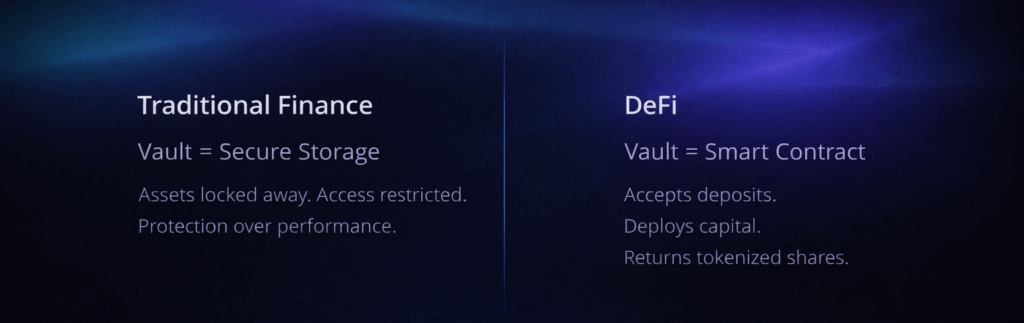
The term entered crypto from two traditions that never reconciled. From traditional finance, “vault” meant secure storage: a cryptocurrency vault built for cold storage, with assets locked away, access restricted, and protection prioritized over performance. Fireblocks, BitGo, and Coinbase all adopted this framing for their institutional custody products.
From DeFi, it meant something different entirely: a smart contract that accepts deposits, deploys capital into yield strategies, and returns tokenized shares representing a proportional claim on the pool. Yearn Finance popularized this pattern in 2020 with its yVaults. Since then, the concept has forked further. Morpho introduced curators who manage risk for pooled depositors. Lido launched modular staking environments with its stVaults in January 2026. Each model uses the word “vault.” Each means something structurally different.
For institutional evaluators encountering these models simultaneously, the vocabulary problem has real consequences. As Josh Kessler, Head of Growth at vault infrastructure platform Veda, has observed: “Vaults are often described as yield products. That framing misses the point.”
What Are the Benefits of Vaults in DeFi?
Before classifying vault types, it is worth understanding why the vault model became the dominant abstraction for institutional DeFi participation.
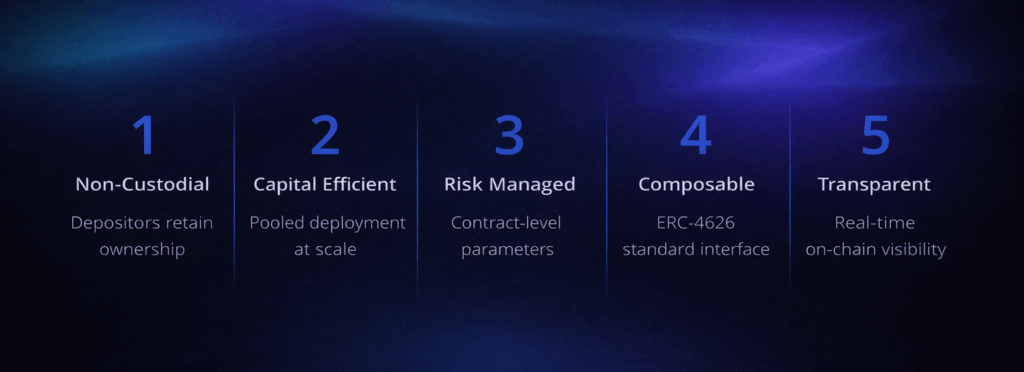
The first benefit is non-custodial architecture. In a vault model, depositors retain ownership of their assets. The vault operator manages strategy and risk parameters but does not take custody. This is a structural departure from traditional fund wrappers, where the manager holds client assets on their balance sheet. Non-custodial design means that if the vault operator fails, client assets are not part of the operator’s estate. For institutional allocators, this changes the counterparty risk profile fundamentally: the risk shifts from who holds my assets to how well is the strategy managed.
The second benefit is capital efficiency. Vaults aggregate deposits and deploy them across yield sources in ways that individual allocators cannot replicate at the same scale. By mid-2025, DeFi lending alone held over $54 billion in total value locked, with Aave climbing from $29 billion to over $75 billion in total deposits by year-end and on-chain collateralized loans reaching $26.5 billion.
The third is structured risk management. Vaults enforce parameters at the contract level: exposure limits, approved counterparties, rebalancing triggers, and circuit breakers that pause operations under specified conditions. For institutional allocators, this means risk controls are embedded in infrastructure rather than dependent on manual oversight.
The fourth is composability. The ERC-4626 vault protocol standard provides a unified interface for tokenized yield-bearing vaults, which means vault shares can be integrated into other protocols, used as collateral, or composed into multi-strategy allocations. This standardization reduces integration risk and creates interoperability across the Ethereum ecosystem.
The fifth is transparency. Unlike traditional fund structures where reporting is periodic and opaque, on-chain vaults provide real-time visibility into holdings, strategy allocations, and performance. Every transaction is verifiable. For compliance teams conducting ongoing due diligence, this is a structural advantage over off-chain alternatives.
The net effect is that vaults have become the interface through which regulated capital enters DeFi. As Kessler has observed: “The number of viable yield sources expanded faster than users or institutions could reasonably operate.” The question for institutional evaluators is no longer whether vaults are relevant, but which vault model fits their requirements.
The Four Vault Types
Custody vaults use multi-party access controls to protect crypto-assets without generating yield. Fireblocks uses multi-party computation to ensure no single entity holds sufficient key shares to sign a transaction. BitGo operates as a regulated Qualified Custodian with OCC-chartered national trust bank status. A custody vault is not a yield-generating instrument.
Pooled yield vaults are smart contracts where multiple depositors contribute to a shared pool managed by a single automated strategy. Depositors receive tokenized shares, often following the ERC-4626 standard. Yearn’s yVaults established this pattern, with over 100 vaults and 250 strategies on Ethereum. A pooled yield vault is not per-client segregated. Assets are commingled; the strategy is shared.
Curator vaults add a designated third party who manages risk parameters, market selection, and capital allocation on behalf of pooled depositors. Morpho defines the curator as the vault’s risk officer and strategist. Gauntlet operates over 70 curated vaults organized into risk tiers (Prime, Balanced, Frontier). A curator vault involves active, discretionary decisions, but the underlying pool is still shared. As Matt Hougan, Chief Investment Officer of Bitwise, has described it: “A vault curator will take in stablecoins and invest in yield-bearing DeFi protocols or generate total returns through some sort of strategy.” Hougan has called this model “ETFs 2.0.”
Dedicated vaults (Sometimes referred to as segregated vaults) are deployed for a single client, providing per-client asset segregation and individual mandate control. The trade-off is higher operational overhead compared to pooled models. A dedicated vault is not a shared pool. Each vault operates under its own mandate.
Comparison Framework
| Dimension | Custody | Pooled Yield | Curator | Dedicated |
|---|---|---|---|---|
| Purpose | Secure storage | Automated yield via shared pool | Professional risk management for pooled depositors | Per-client yield with individual mandate |
| Asset segregation | Provider-from-client | Commingled across depositors | Commingled; curator manages shared pool | Structurally separated per client |
| Governance | Custodian controls security; client initiates transactions | Automated, predefined strategy | Curator sets risk parameters; depositors delegate | Client defines mandate and risk limits |
| Risk isolation | Depends on custody architecture | One depositor's exposure affects all others | Curator decisions affect all depositors | Complete: each vault is independent |
| Capital efficiency | Not applicable (storage, not yield) | High: pooling enables strategies requiring scale | High: curator optimizes allocation across pooled capital | Lower: per-client deployment limits pooling benefits |
| Regulatory considerations | MiCA Art. 75 segregation applies to CASPs | May raise questions about Art. 75 among depositors | Curator allocation may constitute portfolio management under Art. 3(1)(25) | Per-client segregation provides structural clarity for Art. 75 |
What to Ask Any Vault Provider
How are client assets segregated? Separate on-chain addresses, or pooled in omnibus wallets? The distinction between legal segregation (record-keeping) and structural segregation (separate contracts per client) has material insolvency implications. The CeFi collapses of 2022–23 demonstrated that when crypto assets are held under debtor-creditor arrangements, clients can become unsecured creditors.
Who controls strategy and risk parameters? In some models, strategy is automated. In others, a curator makes discretionary allocation decisions. Understanding the governance model clarifies where decision-making authority sits.
What is the operator’s regulatory status? Is the operator a MiCA-authorized CASP, operating under Article 60 notification, or neither? Regulatory status shapes the compliance obligations that apply to both operator and client.
What happens in an insolvency? MiCA Article 75 requires authorized CASPs to segregate client crypto-assets from their own assets on the distributed ledger. Understanding whether client assets are structurally separated from the operator’s estate determines the level of protection.
Frequently asked questions
- What is a crypto vault?
- A smart contract or custodial structure that holds digital assets under defined rules. The term covers at least four distinct architectures, each with different trade-offs for segregation, governance, and regulatory treatment.
- How does a crypto vault work?
- Custody vaults use multi-party access controls. Yield vaults deploy capital across DeFi protocols and auto-compound returns. Curator vaults add risk management where a designated allocator selects markets on behalf of depositors.
- What is the difference between a crypto vault and a wallet?
- Wallets are designed for frequent transactions. Vaults add governance rules, access controls, and often withdrawal delays or multi-party authorization. Many institutional setups use both.
- What is the difference between a crypto vault and staking?
- Staking commits assets to secure a proof-of-stake network and earns protocol rewards for doing so. A crypto vault is a structure that holds assets and applies rules to them; depending on the type, it may deploy into staking, lending, or other strategies. Staking is one thing a vault can do, not an alternative to one.
- What are the different types of crypto vaults?
- Custody vaults (secure storage), pooled yield vaults (shared automated strategies), curator vaults (third-party risk management), and dedicated vaults (one client, one vault, individual mandate).
- What is ERC-4626?
- An Ethereum standard providing a unified interface for tokenized yield-bearing vaults. It standardizes deposits, withdrawals, and share accounting across protocols.
- What happens to vault assets if the provider goes bankrupt?
- It depends on whether assets are legally and structurally segregated from the provider's estate. MiCA Article 75 mandates segregation for authorized CASPs. Without it, clients may become unsecured creditors.
- What is a vault curator in DeFi?
- A third party who manages risk parameters, market selection, and capital allocation for a vault on behalf of depositors. Morpho Vaults are the most prominent current example.
- Can institutions use DeFi vaults under MiCA?
- MiCA does not prohibit DeFi vault usage, but imposes requirements on CASPs providing custody or portfolio management. Institutions should assess each vault model against Articles 75 and 3(1)(25) with qualified legal advisors.
This page is a marketing communication. It is not investment advice, and not an offer, solicitation, or recommendation to use any product.