
Bitcoin Treasury Strategy: From Passive to Productive
Bitcoin has become a meaningful treasury asset for a growing number of companies. MicroStrategy set the tone in 2020 when it became the first public company to add Bitcoin to its balance sheet. Today, nearly two hundred companies hold Bitcoin as a treasury asset, and businesses and governments across thirty-two countries collectively hold around eight […]

Bitcoin has become a meaningful treasury asset for a growing number of companies. MicroStrategy set the tone in 2020 when it became the first public company to add Bitcoin to its balance sheet. Today, roughly two hundred public companies hold Bitcoin as a treasury asset, and businesses and governments across thirty-seven countries collectively hold around nine percent of all Bitcoin in circulation.
The buying spree accelerated through 2025 and into 2026. Public companies now hold more than 1.26 million BTC between them, over six percent of the 21 million that will ever exist, worth roughly seventy-nine billion dollars as at August 2026. Between September and November 2025, several major firms including MicroStrategy, Coinbase, Hut 8, and Strive Asset Management continued to increase their positions. Most added through volatile market conditions, while only a handful reduced exposure, and by modest amounts.
Recent market volatility and the move to fair value accounting have made price movements far more visible in quarterly reporting. Because Bitcoin is trading below recent peaks, many companies now carry holdings valued below their purchase levels, forcing fresh conversations about how to manage those positions.
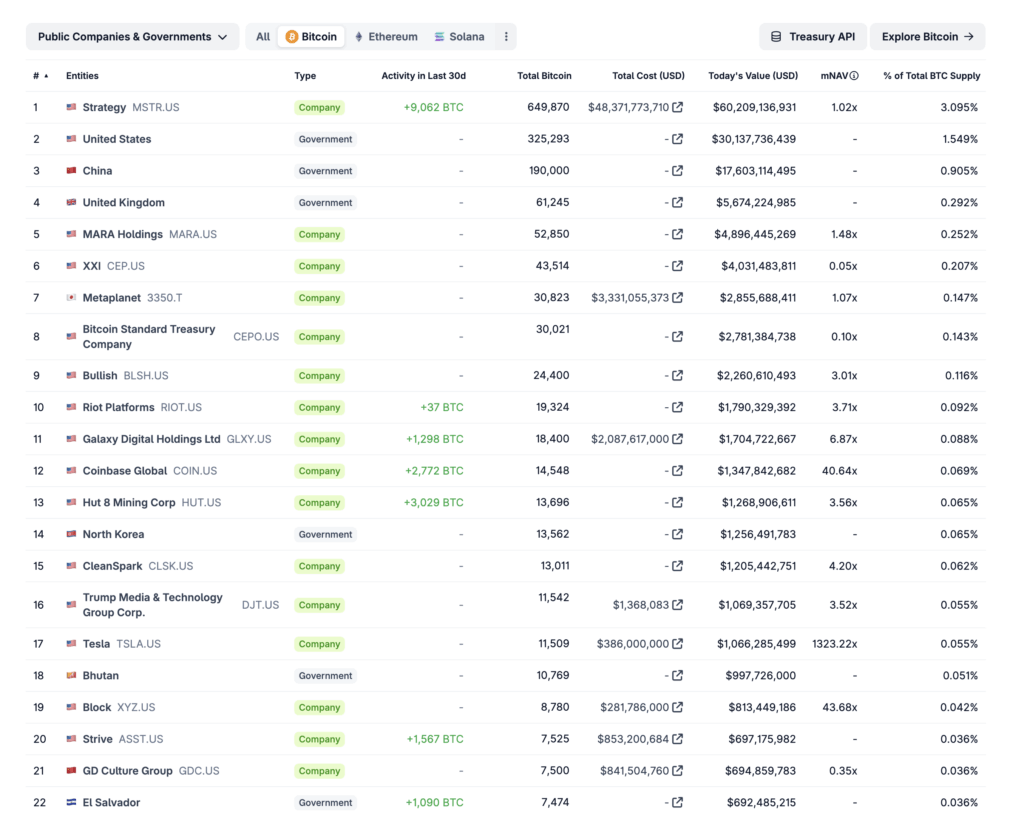
Source: CoinGecko.com
What is crypto treasury management?
Crypto treasury management is the discipline of overseeing a company's digital asset holdings the way a corporate treasury oversees cash and securities: custody, accounting, risk limits, liquidity planning, and, increasingly, return generation. A bitcoin treasury company is a business that holds BTC on its balance sheet as a reserve asset, whether as its core strategy or alongside an operating business.
In practice the job has three layers. The first is security and custody: where the assets sit and who can move them. The second is reporting: under fair value accounting, price movements reach the income statement every quarter, so treasury teams need position-level visibility their auditors can rely on. The third is productivity: deciding whether holdings sit idle or generate a return within defined risk limits.
That third layer is where treasury practice is changing fastest.
Volatility exposes the cost of inactivity
Recent moves in Bitcoin show how quickly unrealized gains can evaporate. From its October 2025 peak, Bitcoin lost roughly thirty percent of its value into that November, and has not recovered those levels since. Companies with big positions in Bitcoin saw that full effect. For treasuries which had accumulated during the 2024-2025 rally, most are now materially underwater, and new accounting rules that took effect in January 2025 mean that drop goes straight into quarterly earnings.
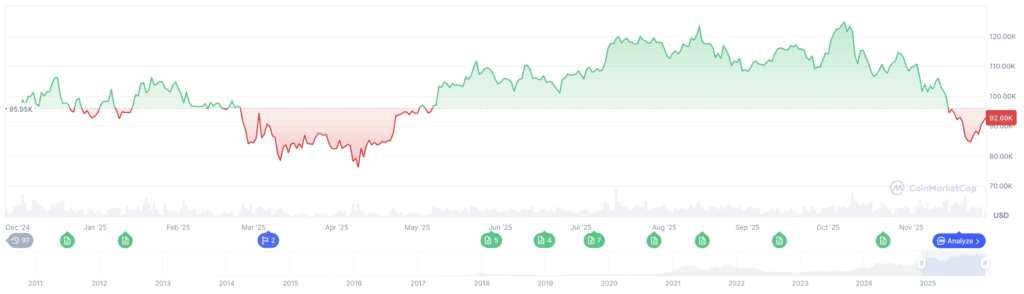
Source: CoinMarketcap
We have already seen how this plays out in real markets. Tesla reported more than two hundred million dollars in losses during the 2022 downturn. MicroStrategy has faced similar paper losses on several occasions. The difference now is that under fair value accounting, both gains and losses pass through the P&L each quarter.
How do firms balance capital preservation with yield generation?
The honest answer is by treating them as one decision rather than two. Capital preservation sets the constraints: custody arrangements, counterparty standards, segregation of assets, and drawdown tolerance. Return generation operates inside those constraints, not around them.
For most institutional treasuries that means three tests before any deployment. First, does the structure preserve ownership, with assets segregated per client rather than pooled with other depositors? Second, who manages the strategy, and under what authorization? Third, is the return performance-dependent and transparently reported, rather than a promised rate that obscures where it comes from?
Finance leaders are looking for ways to offset these swings. Idle crypto earns nothing, yet it still carries real costs. These include custody, operational overhead, and the opportunity cost of capital that could be earning five percent in a cash account. Boards are starting to ask harder questions about what these positions contribute. In traditional treasury management, working capital generates returns. Crypto without a yield strategy sits idle and delivers nothing back to the balance sheet. But earning yield changes that! Rather than absorbing ongoing costs while hoping for future appreciation, treasuries can generate steady income that helps offset expenses and reduces the overall cost of holding the asset.
The shift from holding to earning
Most treasuries that want to grow their digital asset positions usually consider two familiar routes. They can commit new capital, or they can raise funds to increase exposure. Either route needs board approval and has implications for the balance sheet. Yield generation provides another way forward. SharpLink Gaming illustrates what this can look like in practice. The company placed the majority of its Ethereum into staking and, in a single week last month, earned 459 additional ETH through yield worth 1.5 million dollars at the time of publishing. On an annual basis this is close to 80 million dollars in income and several thousand ETH added to their holdings. This result came during a period of wider market stress, yet the company still reported stronger revenue and improved margins with their stock responding positively.
A good comparison is Metaplanet, which follows a passive approach. The Japanese company holds only Bitcoin and reported that its quarterly valuation gains fell thirty-nine percent as the market dropped. Its holdings also slipped below their average acquisition cost, leaving the company exposed to price movements with no offsetting income.
Standard Chartered made a related point in September 2025, warning that digital asset treasury companies whose market value had fallen to or below the value of their holdings would struggle to keep expanding. Its head of digital assets research noted that Ethereum treasury companies were better placed than Bitcoin ones, precisely because staking gave them an income stream Bitcoin treasuries lacked.
For institutional treasuries, this means working with regulated counterparties. After the failures of 2022, the industry rebuilt. Today, European firms operate under the transparency, risk controls, and client asset protections required by MiCA. Treasury teams reporting to boards require this level of oversight. What was experimental has become institutional practice.
What this means for treasuries
For treasuries holding positions below cost, the question is no longer whether to act, but what kind of action to take that makes sense. Fair value accounting means every price swing now hits quarterly results. Idle holdings absorb that full impact with nothing to show for it. Yield changes the picture. While it does not remove volatility, it does turn pure exposure into productive exposure and is a far easier position to defend to the board.
Tesseract Investment Oy, authorized as a CASP under MiCA, works with institutional treasuries to put digital asset holdings to work through Dedicated Client Vaults: discretionary portfolio management in a segregated, per-client on-chain vault. Returns are performance-dependent and strategy-driven, supporting a long-term, accumulative treasury strategy rather than short-term speculation.
If your treasury is assessing how digital assets can contribute more effectively to the balance sheet, our team can provide guidance on yield solutions that support your mandate. Get in touch today to discuss your requirements.
Frequently asked questions
- What is crypto treasury management?
- The discipline of managing a company's digital asset holdings like any other treasury asset: custody, fair-value reporting, risk limits, liquidity planning, and deciding whether holdings sit idle or generate a return within defined constraints.
- What is a bitcoin treasury company?
- A company that holds Bitcoin on its balance sheet as a reserve asset, either as its primary strategy or alongside an operating business.
- How do companies earn a return on treasury bitcoin?
- Through lending, staking for assets that support it, or managed on-chain deployment. Institutional approaches use segregated structures, authorized managers, and performance-dependent returns rather than promised rates. Tesseract Investment Oy provides this as discretionary portfolio management under MiCA.
- Does generating a return eliminate volatility risk?
- No. A return offsets carrying costs and adds income, but the underlying asset still moves with the market, and on-chain strategies carry their own smart contract and liquidity risks. Capital is at risk.
This page is a marketing communication. It is not investment advice, and not an offer, solicitation, or recommendation to use any product.